

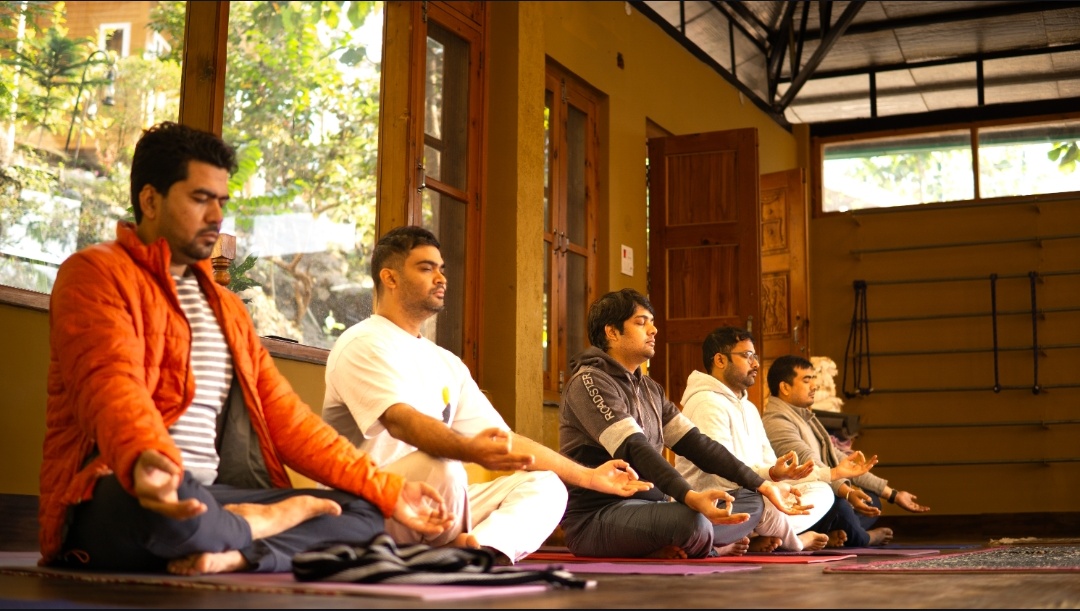
Many of us first notice Ashtanga Yoga as a physical challenge.
Difficult postures, continuous movement, a disciplined sequence that challenges the body at its core. For the first time, it may look like a powerful physical practice, something that builds strength, flexibility, and stamina.
And yes, that’s true. Ashtanga definitely do that.
But when practised correctly, Ashtanga Yoga goes far beyond the body. It begins to shape your discipline, your mindset, and even the way you approach your career as a teacher.
That deeper side of the practice becomes clearer when students learn it at a top yoga school in Rishikesh, where Ashtanga is taught as a traditional form of Yoga, not just a workout.
Let’s explore why learning Ashtanga in the right place can change both your practice and your path as a yoga teacher.
Ashtanga is Just like Learning a New Language
Imagine learning a new language just by attending a few random classes once or twice a week.
You might learn a few words or maybe even some sentences, but you can’t achieve the fluent flow to become a pro.
Ashtanga yoga works in the same way.
It is a fixed sequence, every posture has a right place, every moment connects to your breath, and each step prepares the body for the next one.
When students learn this system at the best yoga school in Rishikesh, they begin to notice the sequence the way a musician notices notes and a writer sees sentences.
It starts forming a proper structure in the mind before beginning any pose.
After a while, you don’t need any instructions to follow the sequence. Your body naturally follows the pattern, like you are practising it for years.
Repetition Starts Showing You Patterns
In many modern yoga classes, the sequence changes every day.
This can seem very interesting, but it also means the body never studies one system deeply.
Traditionally, Ashtanga is quiet opposite of that.
The sequence stays the same. Day after day.
At first, students don’t like the repetition; they find it boring. But something unexpected happens.
When the body repeats the same, you notice the small details that were unnoticed before.
The way your breath shortens when you find a posture difficult.
The way your mind reacts when the sequence doesn’t flow perfectly.
The way focus improves when the movement becomes familiar.
Students practising at a top yoga school in Rishikesh begin observing these patterns easily because they practice regularly without any interruption.
This observation becomes one of the most valuable lessons for the future teacher.
You Start Noticing Effort Differently
Most people approach any physical exercise with one simple thought: push harder and you improve faster.
Ashtanga slowly change that mindset.
Some days the body feels strong, otherdays the same posture suddenly feels difficult. The breath becomes uneven. The balance disappears.
Instead of forcing the positive outcome, students learn something more meaningful.
They learn to notice when effort is helpful and necessary and when it becomes just unnecessary pressure on the body.
During training at the best yoga school in Rishikesh, teachers often instruct students to pay attention to these small signals from the body.
This awareness becomes a strong skill, especially for those who want to teach yoga later in their life.
Teaching is not just about pushing students to make progress.
It is about understanding where they are standing in the process.
The Sequence Teaches You How to Teach
One reason many teachers respect Ashtanga Yoga the most is its structure.
The sequence is so carefully designed that each posture prepares the body for the next one.
This structure becomes a silent teacher.
Students training at a top yoga school in Rishikesh start noticing how transitions work, how breathing controls the flow, and how sequences slowly build strength.
By focusing on such small things, they don’t even realise, but they begin to learning how to design a class.
They understand why some movements come before others, and notice how energy rises and settles down during the practice.
This makes teaching yoga much clearer later.
Instead of thinking about what to include in a class, they understand the logic behind the sequences.
The Practice Changes How You Work With Focus
Focus is not something that comes intentionally during practice.
But Ashtanga demands it.
If your attention gets disturbed even for a few seconds, the breath and moment will lose the connection. The sequence starts feeling chaotic.
So students slowly learn to keep their attention steady.
This comes with consistency in practice.
Students notice that the same concentration begins appearing in other parts of their lives as well.
This seems like a small change, but it literally affects many things.
Learning Ashtanga In A Right Way
Ashtanga yoga is simple but a detailed practice.
Breath, alignment, pacing, and transitions work together as a system.
Learning these details with experienced teachers helps students to understand Ashtanga in a better and clearer way.
This is why lakhs of students globally travel to Rishikesh to learn yoga because yoga education there still holds its strong roots.
At Nirvana Yoga School, students explore the full structure of shtanga while also learning how to teach it responsibly.
For may practicing teachers, studying at atop yoga school in Rishikesh becomes the point where Ashtanga becomes more than a workout; it becomes a system that they learn fluently and can confidently share with others.
